Again, if something really needs to get done, like repairing necessary sewer systems, then it will get done, because it needs to. Do you really think that people who have the skills to repair the water treatment plant are going to just deal with sewage backing up into their home because they don’t want to do the work?
For a more comprehensive analysis of the question, I’d direct your attention towards an anarchist FAQ. I’ll quote a few choice sections below, but the link goes into great detail, comparing and contrasting multiple approaches to handling the problem.
There are some jobs that few, if any, would enjoy (for example, collecting rubbish, processing sewage, dangerous work, etc.). So how would an anarchist society deal with it?
[…]
It would be easy to imagine a free community sharing such tasks as fairly as possible between a community’s members by, for example, allocating a few days a month to all fit members of a community to do work which no one volunteers to do. This would soon ensure that it would be done, particularly if it were part of a festival or before a party. In this way, every one shares in the unpleasant as well as pleasant tasks (and, of course, minimises the time any one individual has to spend on it). Or, for tasks which are very popular, individuals would also have to do unpleasant tasks as well. In this way, popular and unpopular tasks could balance each other out. Or such tasks could be rotated randomly by lottery. The possibilities are many and, undoubtedly, a free people will try many different ones in different areas.
[…]
Of course, no system is perfect – we are sure that not everyone will be able to do the work they enjoy the most (this is also the case under capitalism, we may add). In an anarchist society every method of ensuring that individuals pursue the work they are interested in would be investigated. If a possible solution can be found, we are sure that it will. What a free society would make sure of was that neither the capitalist market redeveloped (which ensures that the majority are marginalised into wage slavery) or a state socialist “labour army” type allocation process developed (which would ensure that free socialism did not remain free or socialist for long).
In this manner, anarchism will be able to ensure the principle of voluntary labour and free association as well as making sure that unpleasant and unwanted “work” is done. Moreover, most anarchists are sure that in a free society such requirements to encourage people to volunteer for unpleasant work will disappear over time as feelings of mutual aid and solidarity become more and more common place. Indeed, it is likely that people will gain respect for doing jobs that others might find unpleasant and so it might become “glamorous” to do such activity. Showing off to friends can be a powerful stimulus in doing any activity.
Do you really think that people who have the skills to repair the water treatment plant are going to just deal with sewage backing up into their home because they don’t want to do the work?
In their own city’s infrastructure? No, probably not. But that doesn’t quite clear things up, so I’ll throw out some numbers as an example:
Let’s say, on average, ~100 pumps need repair/maintenance at any given time.
Only 50 people have the skills to fix those industrial pumps[1].
Do an average of 50 cities have sewage backing up at any given time? How do you fill that gap?
Also, do you have an example of a society that functions like this today? Maybe I’m just stuck thinking inside a box because the society I’m most familiar with is not like that. If so, an example might be helpful.
Obviously only a VERY small fraction of those 50 would be willing to travel to whatever town needs the repair, learn the schematics of their pump model, then swim through their excrement to blindly fix it. But probably easier to just focus on a simpler set of numbers. ↩︎
I mean, sure, if you have 50 meals and need to feed 100 people, 50 people go hungry every day, right? That’s just math.
The best we can do in such a situation is choose a random 50 each day and ensure nobody goes two days in a row without eating. The thing is, though, a free society would respond to that mismatch because people wouldn’t tolerate that situation for long if it can be remedied, right? So people would naturally work to expand the production of meals because everyone wants to eat.
Likewise, people would learn to fix the broken sewage systems. They’d do everything they can to remedy the situation. Workarounds, alternatives, upskilling, and so on.
The question of supply and demand is also covered in exhaustive detail in an anarchist FAQ
Also, do you have an example of a society that functions like this today?
The Zapatistas in Mexico are probably the best example of an anarchist society functioning today. For a historical example, you could also read about Revolutionary Spain. There’s a good section on an anarchist FAQ about it.
I feel like I answered the question completely adequately, but I’d be happy to address your question too.
Why do you think people choose their careers under capitalism? Why would someone choose to be a teacher, a social worker, a mental health counselor, an academic researcher, a vet tech, a graphic designer, for example?
I’d say people choose those careers because they either have an interest/passion for a certain subject/discipline, because they care about improving their community, because they want to help others, or because they just felt like that would be an occupation that suits their abilities. Maybe they chose it because there is some prestige or respect from the peers associated with that occupation. Or, heck, maybe they just chose it because they thought it sounded interesting.
I don’t see why any of that would change at all in an absence of the profit motive.
Good for you! I hope you have a comfortable life, you deserve it - so does everyone, regardless of their career or living situation. What do you do for work?
Remember, though, that your experience is not universal. I chose my career because I was interested and passionate about it. I have friends who feel like their careers just chose them, by pure happenstance. Everyone is different.
Also, do you live with your parents? Because these comments definitely have that vibe.
Thankfully not, I live in a lovely apartment with my extremely handsome husband, who is also anti-capitalist, anti-imperialist and based as fuck.
How about you? Do you live on some billionaire’s sofa, or something? Just curious about why you’re clutching your pearls so firmly about my principled anti-capitalist position. Zero judgment, btw, we are both working class, and I am a huge advocate for working class solidarity.


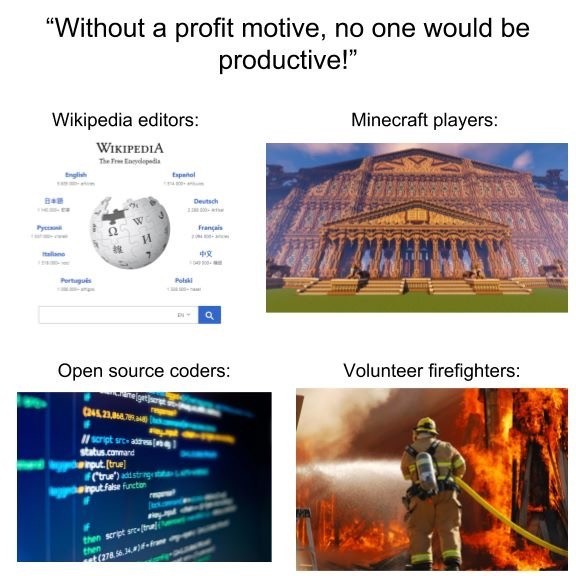
Again, if something really needs to get done, like repairing necessary sewer systems, then it will get done, because it needs to. Do you really think that people who have the skills to repair the water treatment plant are going to just deal with sewage backing up into their home because they don’t want to do the work?
For a more comprehensive analysis of the question, I’d direct your attention towards an anarchist FAQ. I’ll quote a few choice sections below, but the link goes into great detail, comparing and contrasting multiple approaches to handling the problem.
In their own city’s infrastructure? No, probably not. But that doesn’t quite clear things up, so I’ll throw out some numbers as an example:
Do an average of 50 cities have sewage backing up at any given time? How do you fill that gap?
Also, do you have an example of a society that functions like this today? Maybe I’m just stuck thinking inside a box because the society I’m most familiar with is not like that. If so, an example might be helpful.
Obviously only a VERY small fraction of those 50 would be willing to travel to whatever town needs the repair, learn the schematics of their pump model, then swim through their excrement to blindly fix it. But probably easier to just focus on a simpler set of numbers. ↩︎
I mean, sure, if you have 50 meals and need to feed 100 people, 50 people go hungry every day, right? That’s just math. The best we can do in such a situation is choose a random 50 each day and ensure nobody goes two days in a row without eating. The thing is, though, a free society would respond to that mismatch because people wouldn’t tolerate that situation for long if it can be remedied, right? So people would naturally work to expand the production of meals because everyone wants to eat.
Likewise, people would learn to fix the broken sewage systems. They’d do everything they can to remedy the situation. Workarounds, alternatives, upskilling, and so on.
The question of supply and demand is also covered in exhaustive detail in an anarchist FAQ
The Zapatistas in Mexico are probably the best example of an anarchist society functioning today. For a historical example, you could also read about Revolutionary Spain. There’s a good section on an anarchist FAQ about it.
That’s not what they asked.
These are people who have chosen a career in that industry, and spent years training to do so.
Why would someone choose that career path, over, say an artist or fitness coach? What would be their motivation?
I feel like I answered the question completely adequately, but I’d be happy to address your question too.
Why do you think people choose their careers under capitalism? Why would someone choose to be a teacher, a social worker, a mental health counselor, an academic researcher, a vet tech, a graphic designer, for example?
I’d say people choose those careers because they either have an interest/passion for a certain subject/discipline, because they care about improving their community, because they want to help others, or because they just felt like that would be an occupation that suits their abilities. Maybe they chose it because there is some prestige or respect from the peers associated with that occupation. Or, heck, maybe they just chose it because they thought it sounded interesting.
I don’t see why any of that would change at all in an absence of the profit motive.
I chose mine because it pays well.
Also, do you live with your parents? Because these comments definitely have that vibe.
Good for you! I hope you have a comfortable life, you deserve it - so does everyone, regardless of their career or living situation. What do you do for work?
Remember, though, that your experience is not universal. I chose my career because I was interested and passionate about it. I have friends who feel like their careers just chose them, by pure happenstance. Everyone is different.
Thankfully not, I live in a lovely apartment with my extremely handsome husband, who is also anti-capitalist, anti-imperialist and based as fuck.
How about you? Do you live on some billionaire’s sofa, or something? Just curious about why you’re clutching your pearls so firmly about my principled anti-capitalist position. Zero judgment, btw, we are both working class, and I am a huge advocate for working class solidarity.