Do you really think that people who have the skills to repair the water treatment plant are going to just deal with sewage backing up into their home because they don’t want to do the work?
In their own city’s infrastructure? No, probably not. But that doesn’t quite clear things up, so I’ll throw out some numbers as an example:
Let’s say, on average, ~100 pumps need repair/maintenance at any given time.
Only 50 people have the skills to fix those industrial pumps[1].
Do an average of 50 cities have sewage backing up at any given time? How do you fill that gap?
Also, do you have an example of a society that functions like this today? Maybe I’m just stuck thinking inside a box because the society I’m most familiar with is not like that. If so, an example might be helpful.
Obviously only a VERY small fraction of those 50 would be willing to travel to whatever town needs the repair, learn the schematics of their pump model, then swim through their excrement to blindly fix it. But probably easier to just focus on a simpler set of numbers. ↩︎
I mean, sure, if you have 50 meals and need to feed 100 people, 50 people go hungry every day, right? That’s just math.
The best we can do in such a situation is choose a random 50 each day and ensure nobody goes two days in a row without eating. The thing is, though, a free society would respond to that mismatch because people wouldn’t tolerate that situation for long if it can be remedied, right? So people would naturally work to expand the production of meals because everyone wants to eat.
Likewise, people would learn to fix the broken sewage systems. They’d do everything they can to remedy the situation. Workarounds, alternatives, upskilling, and so on.
The question of supply and demand is also covered in exhaustive detail in an anarchist FAQ
Also, do you have an example of a society that functions like this today?
The Zapatistas in Mexico are probably the best example of an anarchist society functioning today. For a historical example, you could also read about Revolutionary Spain. There’s a good section on an anarchist FAQ about it.


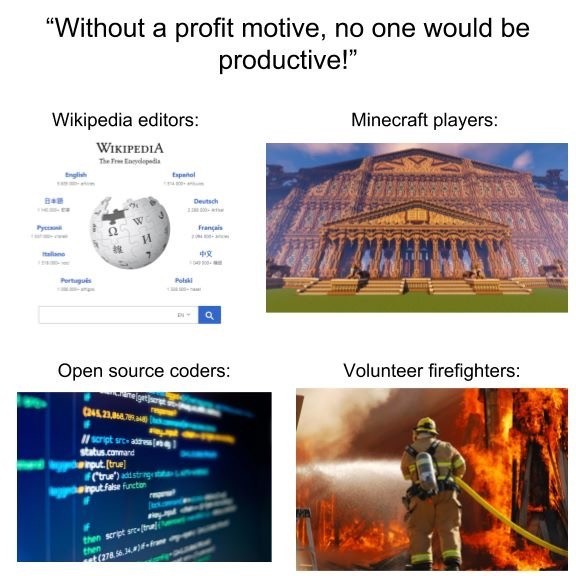
In their own city’s infrastructure? No, probably not. But that doesn’t quite clear things up, so I’ll throw out some numbers as an example:
Do an average of 50 cities have sewage backing up at any given time? How do you fill that gap?
Also, do you have an example of a society that functions like this today? Maybe I’m just stuck thinking inside a box because the society I’m most familiar with is not like that. If so, an example might be helpful.
Obviously only a VERY small fraction of those 50 would be willing to travel to whatever town needs the repair, learn the schematics of their pump model, then swim through their excrement to blindly fix it. But probably easier to just focus on a simpler set of numbers. ↩︎
I mean, sure, if you have 50 meals and need to feed 100 people, 50 people go hungry every day, right? That’s just math. The best we can do in such a situation is choose a random 50 each day and ensure nobody goes two days in a row without eating. The thing is, though, a free society would respond to that mismatch because people wouldn’t tolerate that situation for long if it can be remedied, right? So people would naturally work to expand the production of meals because everyone wants to eat.
Likewise, people would learn to fix the broken sewage systems. They’d do everything they can to remedy the situation. Workarounds, alternatives, upskilling, and so on.
The question of supply and demand is also covered in exhaustive detail in an anarchist FAQ
The Zapatistas in Mexico are probably the best example of an anarchist society functioning today. For a historical example, you could also read about Revolutionary Spain. There’s a good section on an anarchist FAQ about it.