Like, half of the jobs you listed would be automated out pretty quick in a world without money, out of the other ones, a few would be rendered obsolete without profit motive (pretty sure we can find something better for batteries than lithium, and why would you need someone scanning groceries if there was no money?). What’s left can be rotated out or done by lottery, and those doing the undesirable labor get to have more luxury items or whatever. It’s not hard to imagine, people have been doing it for centuries.
We do need incentives to work. As technology and efficiency advances we should be able to work less, but we still need people to do work they/we don’t want to do.
Personally I think people are pretty happy working 24 hours a week even if their job isn’t something they love doing. I’m more interested in working towards that, slowly, over time, than just going to “nobody needs to work”.
Like, half of the jobs you listed would be automated out pretty quick in a world without money
If that was even remotely possible, companies would’ve done that already. Every company tries to cut staff as much as possible.
pretty sure we can find something better for batteries than lithium
Which requires research, which requires investment. Much of the research we currently have only exists exactly because of funding, and a lot of funding is done by companies, not by the government.
What’s left can be rotated out or done by lottery, and those doing the undesirable labor get to have more luxury items or whatever
I like the “whatever”. Let’s just introduce a shitty system that also potentially forces people to do work they don’t want to do and they get like a bar of soap or “whatever” as reward…
It’s not hard to imagine, people have been doing it for centuries.
I don’t know where these people lived that you talk about, but it certainly wasn’t on this planet. Such a system has never existed.
pretty sure we can find something better for batteries than lithium
Trust me, bro
would you need someone scanning groceries if there was no money?
Because this is the most efficient way of keeping track of how many goods leave your moneyless store, and ensuring assholes aren’t just taking everything for themselves and hoarding it. Tracking how many goods leave the store at any given time allows you to order an appropriate amount to keep things in stock so that people who need things don’t go without, and is especially important for perishable goods like fresh produce.
What’s left can be rotated out or done by lottery,
People have different skill sets and specialties. Many jobs take years of training and practice to reach an acceptable level. Also, you just invented state-sanctioned slavery/a non-military draft. What do you do with someone who refuses to perform their lottery-assigned job?
and those doing the undesirable labor get to have more luxury items or whatever.
That’s literally the system we have now, but more authoritarian, since someone has to decide what is a “luxury good” and how much undesirable work is required to attain a given level of luxury.
people have been doing it for centuries.
Citation needed. Concerns: authoritarianism; scaling; maintenance of the modern standard of living
If there are so many refutations, then it should be trivial to point me to one. Assume I am an idiot who doesn’t know how a search engine works - I very well might be. Would you be able to point me to one of these innumerable refutations that would disprove me - otherwise, how am I to learn?
Why do libraries work?
I’m not sure what you mean here. If you explain your point of view, I can explain mine. But I will point out that libraries are not a full, functioning society - just part of one.
Fine. Sure. A few starting points since you asked in good faith:
For historical examples of non-market/cooperative organization, see Elinor Ostrom’s Governing the Commons (1990), which documents real communities managing shared resources without privatization or central coercion. David Graeber’s Debt: The First 5000 Years also covers many societies that operated through reciprocity/obligation rather than modern monetary exchange.
I can point you to some great podcasts if you want.
For historical examples, Revolutionary Catalonia (1936–39) and numerous Indigenous communal systems demonstrate large-scale cooperative production/distribution outside traditional capitalist structures. See the previous Debt: the First 5000 years and just SO MUCH research. Maybe Orwell’s Homage to Catalonia would be a good place to look.
My library point wasn’t “libraries are a whole society,” but that they demonstrate distribution based on shared access/need rather than direct purchase can function effectively. Public institutions already allocate many goods/services this way.
As for undesirable labor, societies don’t need to choose between “profit motive” and “slavery.” Additional leisure, prestige, reduced hours, or enhanced benefits can incentivize difficult work just as effectively as wages. Automation can also reduce much of the repetitive labor currently done purely because it’s cheaper than innovating away the need for it.
I’m not claiming a moneyless society would be simple or easy—just that the idea humans can ONLY organize through profit incentives is historically and empirically false.


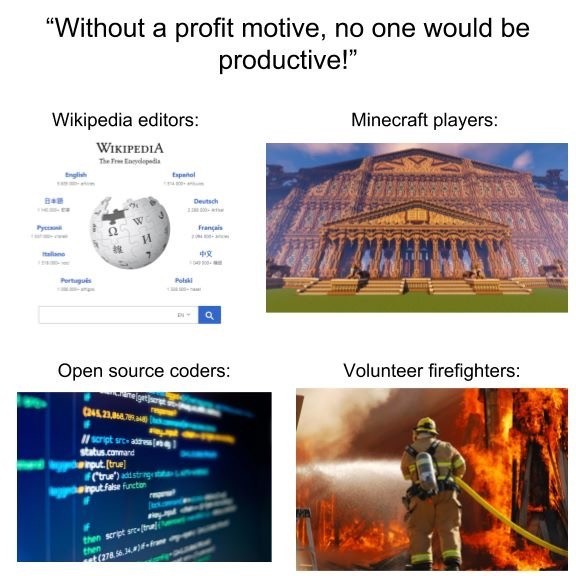
Like, half of the jobs you listed would be automated out pretty quick in a world without money, out of the other ones, a few would be rendered obsolete without profit motive (pretty sure we can find something better for batteries than lithium, and why would you need someone scanning groceries if there was no money?). What’s left can be rotated out or done by lottery, and those doing the undesirable labor get to have more luxury items or whatever. It’s not hard to imagine, people have been doing it for centuries.
Automated by who?
We do need incentives to work. As technology and efficiency advances we should be able to work less, but we still need people to do work they/we don’t want to do.
Personally I think people are pretty happy working 24 hours a week even if their job isn’t something they love doing. I’m more interested in working towards that, slowly, over time, than just going to “nobody needs to work”.
If that was even remotely possible, companies would’ve done that already. Every company tries to cut staff as much as possible.
Which requires research, which requires investment. Much of the research we currently have only exists exactly because of funding, and a lot of funding is done by companies, not by the government.
I like the “whatever”. Let’s just introduce a shitty system that also potentially forces people to do work they don’t want to do and they get like a bar of soap or “whatever” as reward…
I don’t know where these people lived that you talk about, but it certainly wasn’t on this planet. Such a system has never existed.
Trust me, bro
Because this is the most efficient way of keeping track of how many goods leave your moneyless store, and ensuring assholes aren’t just taking everything for themselves and hoarding it. Tracking how many goods leave the store at any given time allows you to order an appropriate amount to keep things in stock so that people who need things don’t go without, and is especially important for perishable goods like fresh produce.
People have different skill sets and specialties. Many jobs take years of training and practice to reach an acceptable level. Also, you just invented state-sanctioned slavery/a non-military draft. What do you do with someone who refuses to perform their lottery-assigned job?
That’s literally the system we have now, but more authoritarian, since someone has to decide what is a “luxury good” and how much undesirable work is required to attain a given level of luxury.
Citation needed. Concerns: authoritarianism; scaling; maintenance of the modern standard of living
I didn’t cite sources because the literal decades and decades of refutations to your arguments already exist.
But I will leave you with this: Why do libraries work?
If there are so many refutations, then it should be trivial to point me to one. Assume I am an idiot who doesn’t know how a search engine works - I very well might be. Would you be able to point me to one of these innumerable refutations that would disprove me - otherwise, how am I to learn?
I’m not sure what you mean here. If you explain your point of view, I can explain mine. But I will point out that libraries are not a full, functioning society - just part of one.
Fine. Sure. A few starting points since you asked in good faith:
For historical examples of non-market/cooperative organization, see Elinor Ostrom’s Governing the Commons (1990), which documents real communities managing shared resources without privatization or central coercion. David Graeber’s Debt: The First 5000 Years also covers many societies that operated through reciprocity/obligation rather than modern monetary exchange.
I can point you to some great podcasts if you want.
For historical examples, Revolutionary Catalonia (1936–39) and numerous Indigenous communal systems demonstrate large-scale cooperative production/distribution outside traditional capitalist structures. See the previous Debt: the First 5000 years and just SO MUCH research. Maybe Orwell’s Homage to Catalonia would be a good place to look.
My library point wasn’t “libraries are a whole society,” but that they demonstrate distribution based on shared access/need rather than direct purchase can function effectively. Public institutions already allocate many goods/services this way.
As for undesirable labor, societies don’t need to choose between “profit motive” and “slavery.” Additional leisure, prestige, reduced hours, or enhanced benefits can incentivize difficult work just as effectively as wages. Automation can also reduce much of the repetitive labor currently done purely because it’s cheaper than innovating away the need for it.
I’m not claiming a moneyless society would be simple or easy—just that the idea humans can ONLY organize through profit incentives is historically and empirically false.
1