If there are so many refutations, then it should be trivial to point me to one. Assume I am an idiot who doesn’t know how a search engine works - I very well might be. Would you be able to point me to one of these innumerable refutations that would disprove me - otherwise, how am I to learn?
Why do libraries work?
I’m not sure what you mean here. If you explain your point of view, I can explain mine. But I will point out that libraries are not a full, functioning society - just part of one.
Fine. Sure. A few starting points since you asked in good faith:
For historical examples of non-market/cooperative organization, see Elinor Ostrom’s Governing the Commons (1990), which documents real communities managing shared resources without privatization or central coercion. David Graeber’s Debt: The First 5000 Years also covers many societies that operated through reciprocity/obligation rather than modern monetary exchange.
I can point you to some great podcasts if you want.
For historical examples, Revolutionary Catalonia (1936–39) and numerous Indigenous communal systems demonstrate large-scale cooperative production/distribution outside traditional capitalist structures. See the previous Debt: the First 5000 years and just SO MUCH research. Maybe Orwell’s Homage to Catalonia would be a good place to look.
My library point wasn’t “libraries are a whole society,” but that they demonstrate distribution based on shared access/need rather than direct purchase can function effectively. Public institutions already allocate many goods/services this way.
As for undesirable labor, societies don’t need to choose between “profit motive” and “slavery.” Additional leisure, prestige, reduced hours, or enhanced benefits can incentivize difficult work just as effectively as wages. Automation can also reduce much of the repetitive labor currently done purely because it’s cheaper than innovating away the need for it.
I’m not claiming a moneyless society would be simple or easy—just that the idea humans can ONLY organize through profit incentives is historically and empirically false.


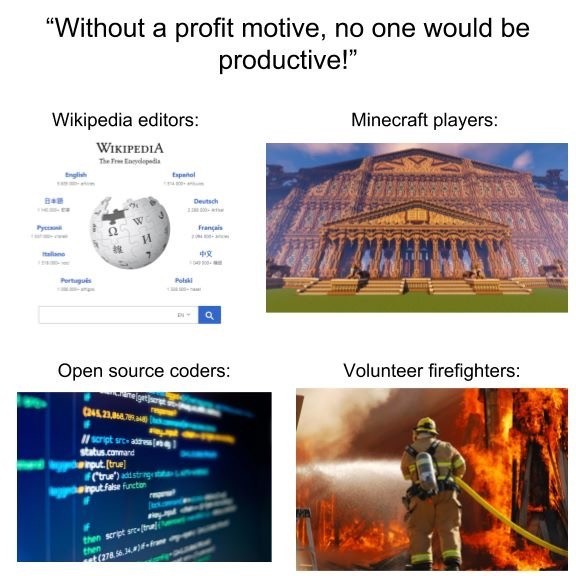
I didn’t cite sources because the literal decades and decades of refutations to your arguments already exist.
But I will leave you with this: Why do libraries work?
If there are so many refutations, then it should be trivial to point me to one. Assume I am an idiot who doesn’t know how a search engine works - I very well might be. Would you be able to point me to one of these innumerable refutations that would disprove me - otherwise, how am I to learn?
I’m not sure what you mean here. If you explain your point of view, I can explain mine. But I will point out that libraries are not a full, functioning society - just part of one.
Fine. Sure. A few starting points since you asked in good faith:
For historical examples of non-market/cooperative organization, see Elinor Ostrom’s Governing the Commons (1990), which documents real communities managing shared resources without privatization or central coercion. David Graeber’s Debt: The First 5000 Years also covers many societies that operated through reciprocity/obligation rather than modern monetary exchange.
I can point you to some great podcasts if you want.
For historical examples, Revolutionary Catalonia (1936–39) and numerous Indigenous communal systems demonstrate large-scale cooperative production/distribution outside traditional capitalist structures. See the previous Debt: the First 5000 years and just SO MUCH research. Maybe Orwell’s Homage to Catalonia would be a good place to look.
My library point wasn’t “libraries are a whole society,” but that they demonstrate distribution based on shared access/need rather than direct purchase can function effectively. Public institutions already allocate many goods/services this way.
As for undesirable labor, societies don’t need to choose between “profit motive” and “slavery.” Additional leisure, prestige, reduced hours, or enhanced benefits can incentivize difficult work just as effectively as wages. Automation can also reduce much of the repetitive labor currently done purely because it’s cheaper than innovating away the need for it.
I’m not claiming a moneyless society would be simple or easy—just that the idea humans can ONLY organize through profit incentives is historically and empirically false.