fun fact: in medieval astronomy/astrology (these things were not yet distinct back then), earth was indeed “mid” as it was the middle of the planets; all other planets circled around it.
later in early modern age, earth was “mid” again but in another sense (the planets circling around the sun was accepted by then). uranus and neptune were not yet discovered, so there were only 7 known objects (+ the moon) in the solar system: sun, mercury, venus, earth, mars, jupyter, saturn. again, earth was exactly in the middle of that order.
You’ve described the Aristotelian-Ptolemaic model which dates back to the 2nd century CE. This was part of, but not the extent of the mideval cosmography.
In the cosmography of the middle ages, there existed a realm outside the spheres where God and the angels dwelled. Each of the planets color the divine light of God and pour God’s beneficence upon the Earth. The earth was low and seemingly distant from the heavenly realms. And in the middle of the earth was hell.
A competing mideval theory put God at the center and the Earth at the most distant sphere. It borrowed from another tradition, the Neoplatonists. Here God is a a pure light and the sphere distort the light of God. Humans couldn’t handle the pure light of God, but all the distortions make the universe appear fractured and not unitary. We don’t see God in everything, just the many things.


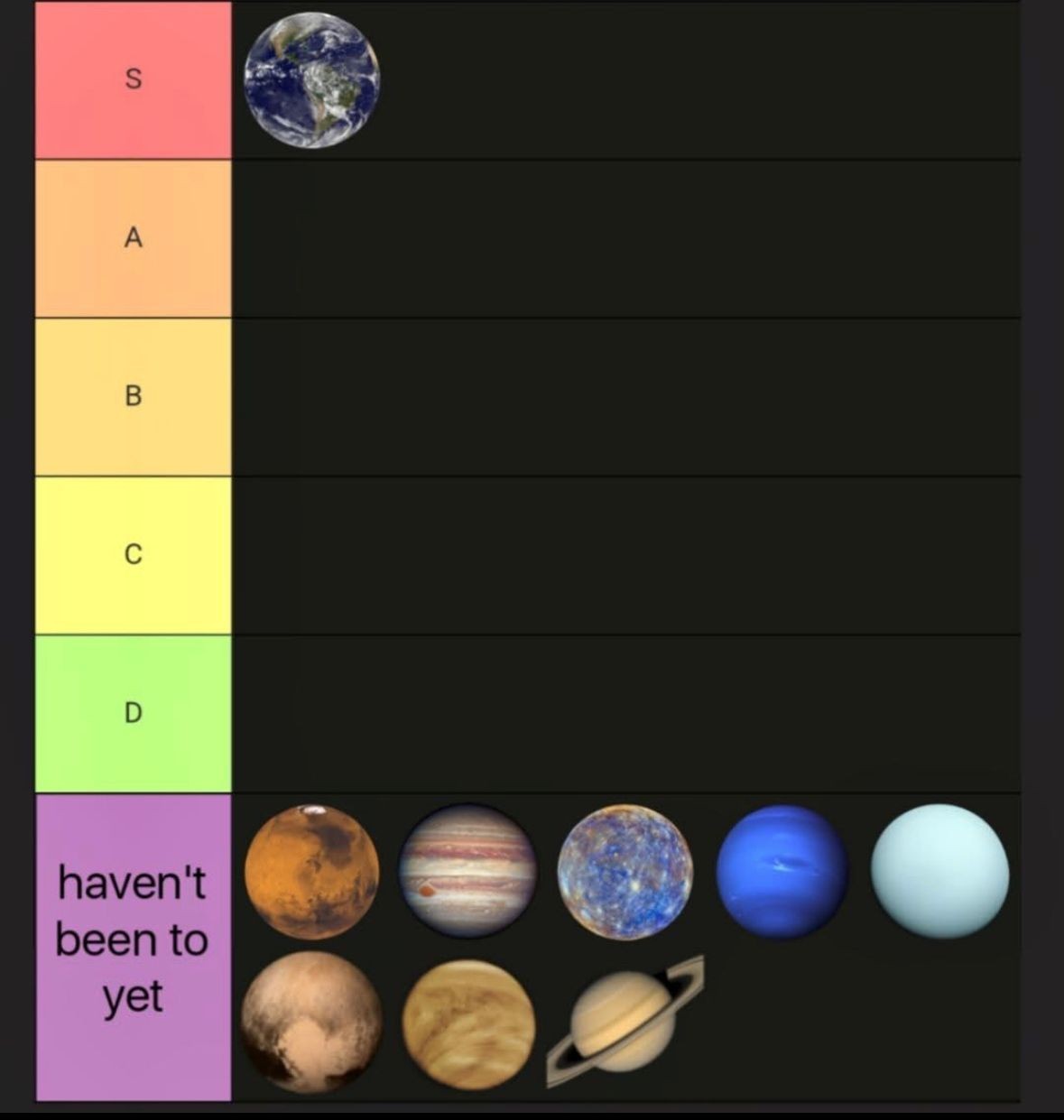
Earth is pretty mid tbh
“I concur. It is unremarkable.”
fun fact: in medieval astronomy/astrology (these things were not yet distinct back then), earth was indeed “mid” as it was the middle of the planets; all other planets circled around it.
later in early modern age, earth was “mid” again but in another sense (the planets circling around the sun was accepted by then). uranus and neptune were not yet discovered, so there were only 7 known objects (+ the moon) in the solar system: sun, mercury, venus, earth, mars, jupyter, saturn. again, earth was exactly in the middle of that order.
You’ve described the Aristotelian-Ptolemaic model which dates back to the 2nd century CE. This was part of, but not the extent of the mideval cosmography.
In the cosmography of the middle ages, there existed a realm outside the spheres where God and the angels dwelled. Each of the planets color the divine light of God and pour God’s beneficence upon the Earth. The earth was low and seemingly distant from the heavenly realms. And in the middle of the earth was hell.
A competing mideval theory put God at the center and the Earth at the most distant sphere. It borrowed from another tradition, the Neoplatonists. Here God is a a pure light and the sphere distort the light of God. Humans couldn’t handle the pure light of God, but all the distortions make the universe appear fractured and not unitary. We don’t see God in everything, just the many things.
Thank you. I feel like we need a community for random knowledge like this.